
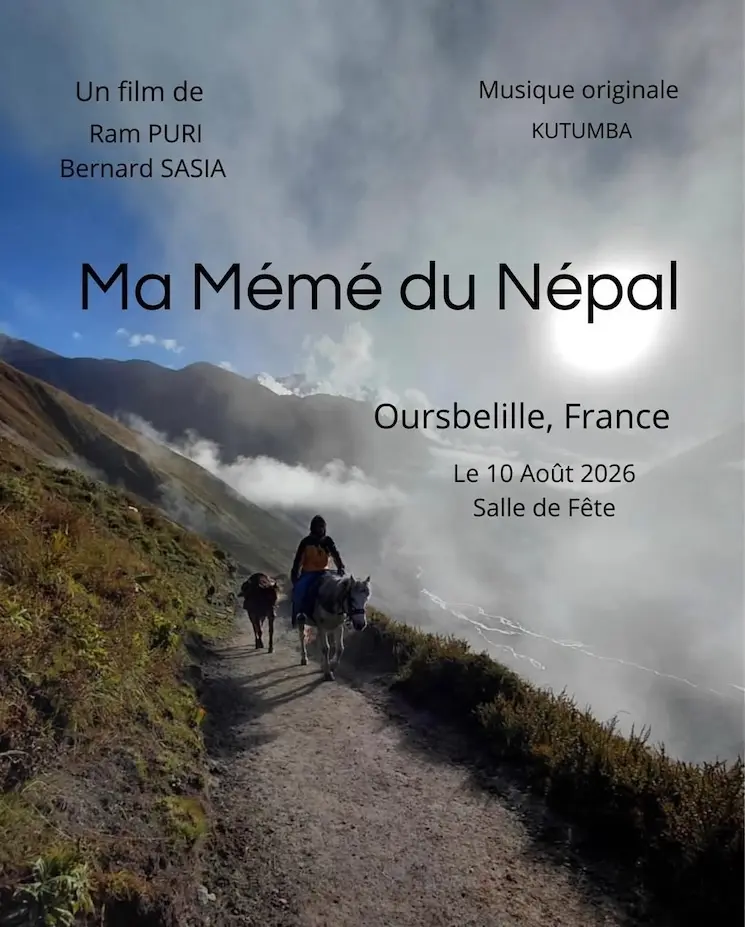
My Granny from Nepal is the result of the meeting between Ram Puri, a French-speaking Nepalese guide, and Bernard Sasia, a French editor and director. Bernard watches the images shot by Ram during his walks in the Himalayas, it is at this moment that he discovers the face of his own "Granny". Their exchanges gave rise to a 90-minute documentary-fiction about a Nepal confronted with the upheavals of its time.
A film born from an encounter and shared images
It all starts with a friendship. The one that is forged between Ram Puri, a French-speaking Nepalese guide, and Bernard Sasia, a French chief editor and director. The two men met in 2019, during a trek in Nepal. Very quickly, a real complicity was established between them. Ram tells us about his country, Bernard shares his experience of cinema and his French view of this society he discovers. From this relationship the idea of a film was gradually born.
In 2021, during a new trek, the project really took shape. Ram already has a lot of footage shot across Nepal. Back in France, Bernard discovered these sequences and proposed to enhance them by integrating them into a cinematographic story. "From our exchanges was born the idea of mixing our two know-hows: my images shot during my various walks through Nepal and his cinematographic skills, to make a film telling the story of Nepal," explains Ram Puri.
The collaboration then continued remotely, between Kathmandu and Paris. Ram sends his images to Bernard, who views them, questions them and edits them. Videoconferences allow the two men to compare their views and specify the context of each sequence. "He asked me questions to understand the subjects discussed. He would give me his opinion and I would answer him live," Ram says. Even the subtitles are worked on remotely. A way of creating together while limiting their air travel, an approach that echoes the environmental concerns of the film.
The title comes from Bernard Sasia. For the director, the word "granny" evokes his own roots and a certain French culture that is less present in everyday language today. When he discovers Ram's images, he thinks he finds in some of the women filmed the figure of his own grandmother and plunges back into his childhood. The title then became a tribute to his "Granny", but also to all the grandmothers of the world.
In the film, the "granny" is not a unique person. She takes on the features of several women Ram meets: hotel managers, shepherdess, student or farmer. For the guide, they are an essential part of Nepalese society. "Women are often the ones who preserve our culture and through whom traditions are transmitted," he says. They thus become the custodians of a memory destined to be passed on to future generations.
Ram Puri, telling the story of Nepal from the inside
Born on a mountain farm to farming parents, Ram Puri left his village for Kathmandu to study journalism and find a job. However, the mountains remain at the heart of his career. "I was born in the mountains, I love the mountains and I wanted to be able to live thanks to them," he explains. The profession of guide also allows him to share his culture and meet people from all over the world. Since 2015, he has been running his own travel and trekking agency in Kathmandu and participates in the training of new guides.
The camera gradually imposed itself in this life of a guide. Ram bought his first digital camera to create videos and promote his treks, but he quickly moved towards a more documentary approach. He began to photograph, film and interview the populations he met during his walks. "I find that video is a very lively medium and a good way to convey people's state of mind, their culture and their way of life," he explains.
His job as a guide directly influences his way of filming. He knows the territories, but above all the populations he meets. This relationship of trust allows her to access remote communities and to collect their testimonies more easily. "People knew me as a guide, they trusted me," he says, believing that this position also allows him to keep his gaze as neutral as possible.
Thanks to the French language, I was able to work and stay in Nepal
A bridge between Nepal and France
The French language is another common thread in her career. Learned at university and then in contact with French-speaking tourists, it allowed him to stay and work in Nepal and to forge lasting links with France. "Thanks to the French language, I was able to work and stay in Nepal," he explains. The Francophonie also paved the way for his two brothers, who in turn learned French and continued their studies or worked in French-speaking countries.
With the travelers he accompanies, the relationship often goes beyond the professional framework. "Most of them arrive as simple travelers and leave most of the time as friends," he says. This is precisely what happened with Bernard Sasia.
During their first trek, the Frenchman was not satisfied with tourist issues. He constantly seeks to compare the French and Nepalese realities. At the end of the trip, the two men decided to continue this dialogue. "It's above all a friendship that grows stronger as we work on this film," Ram sums up.
This relationship finally became one of the common threads of the project. Ram introduces Bernard to his country, while the director leads him to take a different look at his own culture. For the guide, this relationship with foreigners, like the one that was built with Bernard, constitutes what he calls "beautiful globalization".
Telling the story of a country in full transformation
Through his images, Ram Puri documents a Nepal in full transformation. On the environmental front, the changes are particularly visible. For the past twenty years, he has noticed the retreat of glaciers, the overflow of certain high-altitude lakes under the effect of melting ice and the damage caused in the villages below. Farmers also have to change their crops to adapt to the new climatic conditions, while the decrease in pasture is leading to a scarcity of yaks and pushing some herdsmen down to the cities.
Les transformations sont également sociales et économiques. De plus en plus de Népalais partent à l’étranger pour travailler ou étudier, souvent sans revenir. Dans le même temps, le pays connaît des évolutions positives : davantage d’enfants sont scolarisés, l’accès aux soins progresse et les routes désenclavent progressivement certaines régions.
Pour les guides aussi, le métier évolue. Les nouvelles technologies permettent d’améliorer les prévisions météorologiques et le suivi des itinéraires. L’arrivée des pistes et des routes a modifié certains parcours de trek et ouvert l’accès à de nouvelles vallées. Dans le même temps, les visiteurs recherchent toujours l’authenticité, tout en étant attachés à leur confort.
Ces évolutions traversent directement le film. Le Népal n’y apparaît pas comme une montagne figée dans le temps, mais comme un pays confronté aux effets du changement climatique, aux transformations économiques et à l’exode d’une partie de sa jeunesse.
Le Népal, c’est entreprendre un voyage en soi-même, dans son histoire, l’histoire de sa famille, de sa Mémé, de son pays
Ma mémé du Népal, un film entre voyage et introspection
Pour Bernard Sasia et Ram Puri, raconter le Népal ne consiste pas seulement à montrer les sommets de l’Himalaya. Le film invite à redécouvrir la marche comme une expérience humaine, faite de rencontres et d’apprentissage. « Marcher sur les chemins népalais, avec les locaux, c’est la possibilité de rencontres extraordinaires », explique Ram, qui voit dans le trek une manière d’apprendre autant sur l’écologie que sur la spiritualité, l’agriculture ou l’élevage.
Le voyage devient alors un cheminement intérieur. « Le Népal, c’est entreprendre un voyage en soi-même, dans son histoire, l’histoire de sa famille, de sa Mémé, de son pays », résume-t-il. Le film aborde également, sans détour mais avec sensibilité, certaines questions de société, comme la polyandrie, les difficultés rencontrées par certaines femmes ou encore les aspirations d’une jeunesse confrontée aux bouleversements politiques et sociaux.
Cette réflexion s’étend aux modèles de développement. Ram interroge notamment notre dépendance aux énergies fossiles et évoque la possibilité de retrouver certains savoir-faire agricoles plus autonomes. « Une charrue en bois tractée par des yaks fonctionne sans essence. Elle peut être réparée sans avoir besoin d’importer des pièces détachées ni de recourir à des tracteurs fabriqués à l’étranger », observe-t-il.
Le guide se montre également attaché à l’indépendance de son pays. Il rappelle que le Népal n’a jamais été colonisé et souhaite qu’il puisse conserver sa souveraineté. Mais entre l’Inde et la Chine, le maintien de l’identité népalaise constitue selon lui un défi. Il voit cependant dans cette position géographique une possible opportunité économique. « Le Népal a toujours été un lieu de passage entre le Nord et le Sud, pour les marchands comme pour les idées », rappelle-t-il.
Pour lui, l’enjeu est désormais de parvenir à valoriser les ressources du pays tout en évitant que sa jeunesse ne soit contrainte de partir. Le savoir-faire traditionnel, estime-t-il, est menacé mais reste présent dans les montagnes. Il pourrait, selon lui, être utile bien au-delà des frontières du Népal, à condition de ne pas disparaître dans une mondialisation qui tend à uniformiser les modes de vie.
Ram souhaitait accorder une place particulière à la musique. Pour la bande originale du film, il a choisi Kutumba, un ensemble de musiciens formé à Katmandou qui se consacre à la préservation et à la valorisation de la musique traditionnelle népalaise. À travers ses instruments traditionnels, le groupe mêle mélodies ancestrales et arrangements contemporains pour créer une véritable toile sonore, à la fois fascinante et empreinte d’une dimension presque spirituelle. Elle accompagne les paysages et les rencontres du film tout en renforçant son ancrage culturel. Un choix qui contribue à faire entendre, autant qu’à montrer, le Népal.
A universal view
Beyond the story devoted to Nepal, Ma mémé du Nepal ultimately seeks to provoke curiosity. The film is aimed at an international audience and could also, according to Ram, be shown to Nepalese audiences in an adapted version. He himself believes that he has learned a lot from his conversations with Bernard, as he learns from his exchanges with the travelers he accompanies.
This is perhaps where the real point of the film lies. Cultures are not presented as separate worlds, but as realities capable of responding to and enriching each other.
"I would like the film to make you want to be curious, to discover what is different," says Ram. For him, travelling means above all "exchanging, listening, eating differently, walking differently, living differently", even when points of view differ.
From then on, the question of the past and the future becomes central. Ram sums up the spirit of the project this way: "When a film editor meets a Nepalese guide, their Nepalese Grannies become our past and our future." When asked what this formula represents, he says that the film is above all about the future, but about a future that cannot be built without knowledge of the past. "The future is built on what already exists," he says.
Expatriation in Nepal, "a unique living together in the world"
How to see My Granny from Nepal?
As part of its 2026 summer tour, the documentary film "Ma mémé du Nepal" was screened on August 3 in Saint-Cirq-Lapopie, in the Lot, then on August 10 in Oursbelille, in the Hautes-Pyrénées, before a final screening on August 14 in Canillo, Andorra. These sessions were accompanied by discussions with Ram Puri about his experience in filming, documentaries and his view of Nepal.
The film should now continue its journey. Ram Puri hopes to be able to present it at festivals dedicated to mountain cinema.
To follow the news of "Ma mémé du Nepal" and discover the next dates and places of screening, find Ram Puri on his Facebook page.